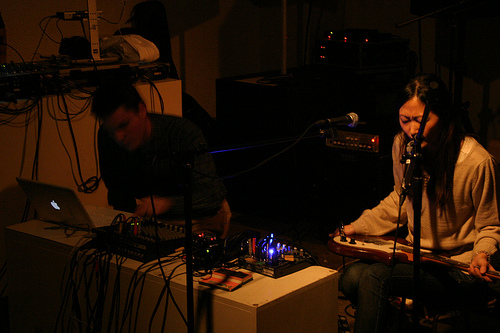
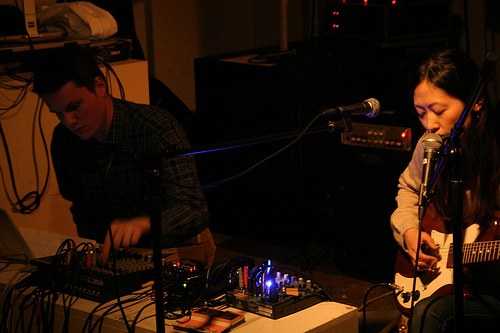
Posts from the Celer Category

This is the first release of Danielle’s Chubby Wolf project on vinyl, and the first release since ‘Ornitheology‘ last year. It will be released in early April from Low Point.. both tracks can currently be previewed here: Low Point

Press release:

“Time moves differently with Chubby Wolf’s latest work of fluid sound art….more than a single, you’re embraced and carried, pulled gently in one direction, urgently in another. You feel Dani had woven a tapestry of emotional choreography just for you. As with all her work, there is a sense of a personal touch…a slight weight of a hand on the shoulder, your skin gone electric where her sound has lifted you.

We sadly do not know what Dani’s exact intentions were with this music. Our only direct hint the title, ‘The Darker Sex‘. Even that, like a game of playfulness or frustration with a lover…which is the darker sex? But don’t you know? All of her work was a labor of love and gift to the world, and I believe we were meant to feel more then define. For here purgatory is not flat, it is pregnant and undulating with expectation and anticipation…and above all else, an effervescent timeless beauty. We will want to stay a while.” – Maile Colbert, March 2011

Danielle Baquet-Long: Voice, electric guitar, synthesizer, surpeti, drum machine, violin, bells, tambourine, piccolo, ghunghara.

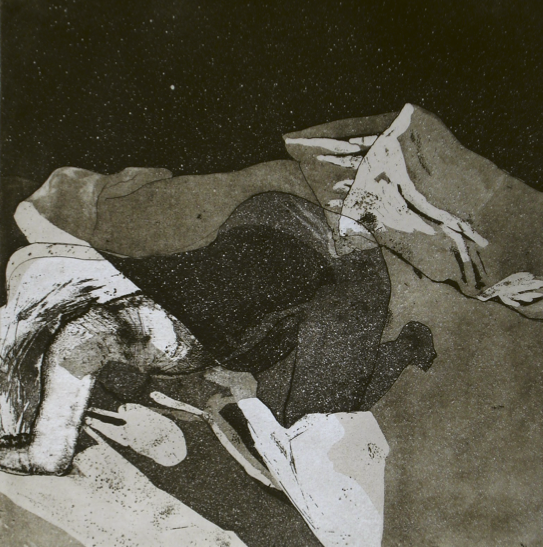
Cover artwork by Jennifer Chen. Mastered by Corey Fuller.

The opportunity to collaborate with the globetrotting duo of Celer was taken by Yui Onodera as a chance to explore his Tokyo close up and with fresh ears. He compiled a wide array of field recordings ranging from migratory geese who only make one, short pitstop in town a year, to chanting worshippers, kids playing in the school yard and rainwater flowing from an eavestrough.

Onodera is keenly aware that the key to creating something authentically, universally appealing is to keep it local. Celer, Will Long and the late Danielle Baquet-Long, whose prodigious discography features sounds recorded as far afield as the Mediterranean Sea and the wheat fields of Texas, collected their own impressions of Los Angeles.

Both recorded plenty of to-ing and fro-ing, the urban rhthym of movement on the street, mass transit and airport departure gates. The goal was to create a ”generic city”, and they have succeeded in fusing the two cities into a single, immediately recognizable one, not for its monumental parks and skyscrapers or unexplored backstreets, but for its interaction of people and architcture, architecture and the environment, the environment and the fast pace of change characterizing any major metropolis.

And yet they position the listener at a fixed point in the middle, most palpably on the beautifully drawn-out ”Waiting for Something Else to Happen”, watching the passing parade as if in colourful slow motion. Detail is rich and images are sharp. Onodera alludes to reminding the listener of the the commonalities lost our incessant global chatter. A gentle commonplace, perhaps, reflected by the short music-box trill inserted to conclude the radiant opening track, ”An Imaginary Tale of Lost Vernacular”.

Generic City is the first release on the Two Acorns label, founded by Long last year with the intention of keeping the physical object relevant in an age of invisible information storage. And as an object, this album, its music and its artwork will long enjoy pride of place on the shelf.

Link

As 2011 begins, I’ve been working to start making music again.

Many of these things are just pieces of daily life, but not always fit for

publishing on labels. However, they are important, just as anything that

happens in our daily lives. They will be posted for very inexpensive prices

in their full quality, and all proceeds go directly to me, which will help me live.

Any, and all support is greatly appreciated. Thank you for your kind interest, always.

Sincerely,

Will

Link

In the eighteen months since Danielle Baquet-Long passed away, there have already been upwards of a dozen albums worth of material released which were recorded by her and her husband Will Long before her untimely death. Especially given the quiet, introspective nature of all this music, there comes a point where you have to wonder just how much more there is to say, or how many ways there are of saying it; even the title of this latest album may almost be verging on self-parody. But not for the first time, I’m confounded; once again I have found myself buying a Celer record, listening to it, and being stopped in my tracks by the powerful glare from its reflections. This new album, Vestiges Of An Inherent Melancholy, is a captivating journey – not just to a particular country, and to a particular time, but also to a very particular, and very personal, state of mind.

Vestiges Of An Inherent Melancholy is Celer’s second LP for the Blackest Rainbow label, after the dense collage of dark, deep, drones that was Dwell In Possibility. Despite the typically lengthy list of source sounds on Vestiges (cello, violin, pipe organ, field recordings, tape, samples, electronics), it is a simpler, and much more emotionally direct construction than that release. The front cover is decorated with a photo of Buddhist prayer flags draped across a dusty street, the bright colours seemingly having been drained from it by the ravages of time: it was in fact taken nine years ago by Baquet-Long during a lengthy stay in Nepal. Two “tracks” (while nine are delineated by title on the record’s sleeve, they seep into each other to effectively give two long continuous pieces) also feature field recordings made in Kathmandu.

Nepal is a country of such dramatic contrasts, from the warm, lush, tropical rainforests of the south to the cold, rocky Himalayas of the north, from the simplicity of rural living to the capital’s many complexities. In 2002, in both the peaceful Buddhist villages and the bustling chaos of the (primarily Hindu) capital there must have been a sense of exhaustion, worry and hope about recent events and forthcoming changes. A royal family had just been all but wiped out, an event which, when combined with a strengthening Maoist faction, was destined to lead to dramatic changes in the state’s status, changes which have still not fully stabilised. Vestiges Of An Inherent Melancholy is equally full of contrast, with those sections of extremely animated (and even slightly frightening) chatter slicing into sections of prayer-like serenity, with lush melodies appearing from amidst barren backdrops.

But much more than being simply an ode to Nepal, it feels like it’s more generally a reflection on transition, on a time when sadness for what was being lost was tempered by hope for the future. A quote from the film The Third Man on the album’s second side brings us back to post-war Vienna; similarly broken, burnt out and yet somehow optimistic. Yet underpinning the album there is that sensation, common to the hauntological musical canon, that all has not turned out as was hoped; that, to quote from Leyland Kirby’s most recent project, “sadly, the future is no longer what it was”. Sad, slow snatches of orchestral melody seem doomed to play out over and over, degraded and withered with time, giving much of the album the mood of work by Philip Jeck or indeed Kirby himself. The happy songs of old are transformed by the passage of time into something very different, very personal, and very poignant. When taken in conjunction with everything we know about the premature end to the Celer project, these Vestiges Of An Inherent Melancholy are at times almost unbearable.

Link

By now, most readers are familiar with the story of Celer.  Celer was the duo of Dani Baquet-Long and Will Long, but after Dani’s untimely death, Will continued to soldier on, enriching her musical legacy by releasing a seemingly inexhaustible sequence of discs featuring their entwined work.  If a name can predict the outcome of one’s life, then Will must certainly feel fated, but the interpretation of his nomenclature is yet to be determined.  Is the artist one of will, or one who will long?  Hell Detoured provides a tentative answer.  It’s not as dark a recording as one might have imagined, given its title; its gentle tape loops rise in and out like breath.  Perhaps the detour around hell – in this instance, a personal, inner hell – leaves Despair dissatisfied: the very nature of art as healing.  Many of Celer’s projects have been over-ambitious, attempting to say too much by painting on too grand a canvas.  Due to its focused nature, this release says much more than its brief running time might suggest.  As a result, it’s one of the finest recordings in the extensive Celer catalog.

Link

Will and Dani’s 32nd full-length album suffers from many of the same flaws found on their second record. Broken up into 29 distinct songs, Capri sees Celer attempting to alleviate the monotony of their mostly monochromatic music by introducing intermittent asides. Unfortunately, many of the songs represent only a nominal change, and the record frequently sinks under the weight of its own routine.

Maybe I’m doing it wrong. Maybe I should be listening to Celer the same way I sometimes listen to SleepResearch_Facility or La Monte Young, by not giving it my full attention. The two albums I have heard suggest Celer’s music belongs in the background anyway. It is typically repetitive, simple, and diffuse, aspiring toward environmental noise more than a recorded object of focus, but unlike the music of Kevin Doherty and The Theatre of Eternal Music, it is both timid and tepid. Probably because they were hesitant to commit to any one approach, Will and Dani’s music sounds muddled and indecisive. In this case, it’s as if two different records were forced together on one CD-R, each with its own theme and goals. That lack of focus is the primary reason their music fails to impress me, and their superficiality is a close second. Numerous editing issues and a nearly colorless instrumental palette only bog the record down more.

Unlike Ariill, however, some major surgery could save this record. Sandwiched between the longer drones that compose most ofCapri are a number of brief vignettes. Some are pleasant, but more than a few sound alike, while others sound completely out of place or altogether unnecessary. Getting rid of those tracks would relieve Capri of a lot of dead weight, give it more punch, and cure a good deal of the monotony that plagues it. Cutting some of the longer drones out of the record would help, too. Nearly all of them exhibit the same colors, textures, and moods, and not one of them succeeds in sounding like anything more than a washed out blur of sound. Toss a few of those out and Capri feels even lighter and more focused. Beneath all the fat is a coherent record of weightless drones, even if most of them are one-dimensional.

Since field recordings play a central role in their compositional method, I would expect more dynamism and variety from their music. But, nearly every drone and sustained note on Capri is flat and shallow, which is a shame because Celer sound great when they allow texture and variation into their sound, as both “Braclets Passed to Spanish Hands” and “Sonata For Dual, Unaccompanied Piano” attest. A little more discipline would help Celer tremedously.

Link

Celer add to their voluminous catalogue with this two track (18 minutes each) release on Blackest Rainbow… If you’ve previously heard Celer, you probably know what to expect; gentle washes of sound immersed in ever-expanding reverb, subtle shape-shifting phrases, and field recordings weaving themselves through and between tracks. It’s an approach that is instantly and unmistakeably identifiable as this pair’s work. So, while there are no surprise forays into death metal or jazz-flecked jungle here, what we have is a beautiful release that ticks all the right boxes. Delicate, almost subconscious melody? Check. Deep, drifting ambience? Check. Gently transforming structures? Check. The two tracks are evocative and glacially mesmerising – yet with such a strong and immense catalogue already released, one can’t help but feel a little like it’s been done before. It’s almost Celer-by-numbers. New listeners will be bewitched and enthralled by these two tracks – they have an undeniable sensuous majesty that would be intoxicating to fresh ears. Even seasoned Celer fans will, no doubt, fall instantly in love with this release – it IS stunning – but I can’t help but wonder how long these (presumably) archival recordings can continue to be released at their current pace and not threaten to ‘cheapen’ the Celer experience. I have a lot of love for Celer – in fact, I think this release is a particularly strong showing; richly melodious and impressive – however, too much of a good thing….

Link

Celer is not the amazing ambient and drone unit that every blog, webzine, and message board in the universe claims it is. At least, Ariill doesn’t prove it. Released as a pair of free MP3s in 2007 by Archaic Horizon and presumably related to a self-released CD-R of the same name from 2005, these two half-hour drones represent the start of Celer’s prolific four-year run, which I assume yielded better music than this.

Following Anthony D’Amico’s review of Vestiges of an Inherent Melancholy, I sought out whatever information I could about Celer. All the blogs and message boards I found trading their music made it sound as though Will Long and Dani Baquet-Long’s recorded output was a heavenly ambient gospel inspired by the same gods that Jacob Kirkegaard, Chris Watson, and Rosy Parlane proclaimed. Such comparisons and high praise sent me looking for anything I could find by them. Thanks to Archaic Horizon, I didn’t have to look far, because they provide Ariill absolutely free of charge on their website.

A paragraph or two can be found there that tries to describe Ariill’s central conceit, but it’s poorly written and more confusing than helpful. The grandiloquent description only explains that these two pieces began life as piano sonatas and were transformed into something new using a relatively simple looping process the band refers to as “triangular synthesis.” There’s a diagram included with the download that is supposed to make that process easier to understand, but it’s entirely unnecessary and only makes Celer look pompous. Whatever they did to transform their piano music into respiring drone noise, the effort just wasn’t worth it.

During the first half-hour, distorted tones, which are stretched to the breaking point, crackle and stutter amidst steaming vents and a rippling, nearly melodic background. The effect is a pleasant one, at least initially, but after 15 minutes it becomes tedious. There is no development, nor is there much in the way of depth, and after just a couple of minutes the song is essentially spent. But Celer keeps the same thing going for an additional 28 minutes. Only very minuscule elements are added or subtracted, so that by the end all I can hear is a repetitive, grating noise, like Charlie Brown’s mom speaking through a broken megaphone. It isn’t meditative and it isn’t poetic, it’s just a long, plodding exercise in generic feedback manipulation.

The second half-hour manages to be worse. A single undulating tone begins the song, and over the course of 32 minutes it is transformed by various effects and the addition of other tones, which interfere with it. As these echoing sine waves lap over one another, distorted chunks of audio similar to those from the first song pan across the stereo in short fits. Again, the effect is pleasant enough at the start, but prolonged exposure generates only frustration. Making matters worse are a number of abrupt frequency changes, where the song’s central tone is either lowered or raised in a distracting and unpleasant way. Without them the song would be better, but it would still go on for far too long.

With some editing, Ariill might have been a fine EP of under-produced drone, but as a full-length release it is severely flawed. Even in abbreviated form, it would lack the color and ingenuity found so abundantly in the music of people like Andrew Chalk or Jonathan Coleclough (check out Jonathan’s Period for an excellent example of highly processed, piano-derived music). It isn’t hard to imagine that Will and Dani released better music during their short time together; this is only their second release, after all. But, for now, I have to conclude that if Celer is as great as everyone says they are, the proof is somewhere else, on one of their other 57 releases.
Link

This unique husband-and-wife duo only existed for a few short years, but during that tragically brief window, they managed to record and release such a staggering avalanche of material that even Masami Akita might raise an eyebrow at their tireless pace.  As such, navigating their sprawling discography of mostly limited edition releases is a daunting and complicated task, particularly since the difference between great minimal drone and not-so-great minimal drone is very blurry and difficult to articulate.  Thankfully, this (one of their rare few vinyl releases) provides an excellent starting point.

The works here were culled from recordings made by Will Long and Dani Baquet-Long over an 18-month period ending in July 2008, about a year before Dani unexpectedly died from heart failure.  Although  presumably absent from the mixing and assembling of the finished album, Baquet-Long’s presence remains quite prominent, as she posthumously provides many of the album’s most vibrant elements through her field recordings from Nepal and her perversely festive cover art.   Also, of course, she is responsible for a lot of the music, though it is nearly impossible to tell which instruments are being played at any given time (or by whom), as the Celer sound is heavily blurred and processed.  Their closest stylistic kin is probably Disintegration Loops-era William Basinski, as both artists have a propensity for repetition, haziness, and slow-motion drifting, but there are some considerable differences as well.

In characteristic Celer fashion, each side of this release is essentially comprised of just one lengthy piece, but given multiple titled sections that are quite difficult to isolate. The music itself is essentially drone in the most “drone” sense possible, as the pair employ their arsenal of pipe organs, strings, and tapes to create a vaporously shifting bed for a host of swelling and shimmering other indistinct sounds to emerge from and disappear back into.  Such an aesthetic has the potential to be a bit on the dull side, but Celer wisely intersperse their narcotic reveries with untreated field recordings of boisterous crowds from Dani’s stay in Kathmandu (as well as a particularly poignant old movie snippet).  The overall effect is like being in an alternately warm and eerily desolate dream, but sometimes drifting back into semi-consciousness to find a somewhat unfamiliar world.  It can be a bit disquieting and sad, but it can also be quite absorbing.

While some of this material was recorded as much as four years ago and has mysteriously avoided being released by a duo that that has historically had no problem in hitting double-digits for releases within a single year, Long has succeeded in shaping the orphaned pieces into a very coherent and satisfying whole.  I am by no means a Celer completist, but Vestiges of an Inherent Melancholy does not fall far short of my current favorite Celer release (2009’s Capri) and offers the added perk of not being out of print (also, the glossy cover art is rather striking too, for people who like pretty things).

Link