Posts from the Celer Category

Though promising collaborations are a regular enough occurrence in underground music, seldom does the whole exceed the sum of its constituent parts. However, this final instalment in a trilogy of 7-inch singles from Celer and Machinefabriek is happily a case of two musical styles complementing each other quite perfectly, resulting in two short tracks of top-tier ambient exploration which can’t help but leave this particular listener wishing for more.

Hei/Sou comes with vintage Japanese postcards and follows similarly carefully packaged releases from the Celer and Machinefabriek pairing, named Maastunnel/ Mt. Mitake and Numa/Penarie, respectively. Like its predecessors, the creation of the two-sided single was facilitated by the internet, connecting the Rotterdam-based Rutger Zuydervelt and Tokyo resident Will Long over thousands of miles and several time zones.

Despite the artists’ significant physical distance from each other though, the music contained within this release feels like a cohesive whole and both of the two roughly five minute numbers contain sonic touches from each artist, lending Hei/Sou the appearance of a truly joint effort, with gentle soothing drones joined by subtle electronica to great effect. Each track is a fine example of subtlety and understatement, and Hei/Sou is also bundled with two accompanying videos by Marco Douma which lend an additional perspective to the music.

While this author doesn’t wish to hazard a guess as to where this work stands in regard to the voluminous previous works of Machinefabriek and Celer, it does feel like one of the better offerings from both in recent months and one can only hope that this inspired pairing continues to produce such results.
Link

Due compositori prolificissimi e avvezzi alle lunghe durate alle prese con il difficile esercizio della concisione: alla fine dello scorso anno, Will Long e Rutger Zuydervelt hanno intrapreso una collaborazione, dapprima sfociata nei due brani di “Maastunnel/Mt. Mitake” e alla quale viene adesso fornito stabile seguito in quella che sembra destinata a essere una serie di 7” in vinile.

I due brani di “Numa/Penarie” provengono da una serie di più articolate registrazioni, condensate in dieci minuti che mantengono fede alle loro componenti d’origine, evidenziando da un lato le impalpabili texture dell’artista americano e dall’altro le sperimentazioni analogiche di quello olandese.
Lungi dal costituire rappresentazioni brevi ma monolitiche, i due brani seguono un percorso di continua trasformazione: in “Numa” tremule ondulazioni raggiungono il grado di saturazione per poi venire puntellate da qualche pulsazione e da variopinti detriti sonori, mentre le più evidenti tastiere della prima parte di “Penarie” lasciano gradualmente spazio a modulazioni vaporose e quasi romantiche.

Si direbbe dunque un esercizio pienamente riuscito, che tuttavia potrebbe suscitare qualche interrogativo sull’enorme mole di produzioni di entrambi gli artisti, che qui dimostrano di saper concentrare addirittura in miniature di pochi minuti molto di quanto solitamente espresso in dischi interi.

Link

Epicentral Examples of the More or Less now available for preorder, direct from Futuresequence:

http://www.futuresequence.com/releases/epicentral-examples-of-the-more-or-less/

Press release:

Celer is the solo ambient project of sound artist Will Long, who works out of Tokyo, Japan. He is well known for producing dense, emotive creations that are never lost in the gloom of myriad other ambient releases, due to the remarkable delicacy of each layer of sound in his pieces, which never become overwhelming or too drawn-out to to sustain their initial emotional content, as is so often the case with many extended ambient compositions.

Indeed, the thought that goes into Celer releases is evident from the incredibly detailed titles that Long has given to each of the three tracks on Epicentral Examples of the More or Less, with each small portion of the title being relevant to an individual phase within each overall track – an arrangement choice which is made, on listening, into a feat of compositional skill, due to the fact that the tracks, even when starkly cutting between samples of reversing tapes, field recordings, and Celer’s trademark throbbing, glowing drones, at no point ever sound merely like a compilation of small pieces. Rather, the album remains cohesive overall, and whilst at points the listener is met with surprises in the form of phasing waves of bright sequencers – a sound that many would never have imagined Long using after listening to releases such as Evaporate and Wonder – or even acid-house synth waves on Fill Your Light With Lessness from the third and final track – Epicentral Examples of the More or Less retains the genuine emotive content that has become a cornerstone of Celer releases, coupled with a creative talent that leaves most contemporary ambient music dead in the water.

Recorded over two years in Jakarta, Indonesia and Tokyo, Long appears to have had time to revisit these recordings over and over again, allowing him to produce a release that is simultaneously a step forward for Celer’s sound, and the level of musical wizardry that the rest of the ambient scene must now aspire to reach.

While some on holiday are sucked into over-crowded commercial tourist traps, and others are off in their resorts or private villas, some of the most memorable places and experiences are the somewhat unusual, even off the beaten-path locales.  Picture postcards often contain brief accounts or memories of travels to these places, being descriptive, cryptic or comical anecdotes of a given day’s events, compressed into a few short phrases—a substitute for longhand letters.  They also serve to freeze a moment in time in a more permanent and retrospective fashion than the immediacy of a quick e-mail or photo sent via the internet.   These moments in time are what the trilogy of releases by Celer (Will Long) and Machinefabriek (Rutger Zuydervelt) are like.

It started when they performed together in November, 2010 in Tokyo, Japan and then decided to collaborate remotely on a series of short releases beginning in October, 2011 between Tokyo and Rotterdam.  The pieces started as larger works and eventually were edited into musical postcards, or drone poems* of sorts, evoking a place, event or state of mind.  Artwork found by Long in Tokyo has been used for the covers of the 7 inch vinyl releases with design and graphic layout by Zuydervelt.  As much as I appreciate the convenience of digital-format music, there is something quite special about the 7 inch record, packaged in artful sleeves of re-purposed postcard and souvenir images.  Even better, each piece is accompanied (via download) by a beautiful and timeless video interpretation by multimedia artist Marco Douma.

The soon-to-be-released Hei/Sou is the last in this trilogy.  Maastunnel/Mt. Mitake and Numa/Penarie were the first two releases.  Digital files are also available and the vinyl pressings are limited to 250 copies each (Maastunnel/Mt. Mitake vinyl is now sold out).

Maastunnel/Mt. Mitake are readily identifiable places.  Maastunnel is a tunnel in Rotterdam and this track has some mystery.  The piece opens on the outside approach to the tunnel (with the ambient sounds of water).  There is an apparent twist in the plot where voices can be heard, “I didn’t see his face…he might have been just anybody…just anybody.”  Suddenly, a break to the interior where vehicles are passing over expansion joints creating pulses that resonate throughout the underground structure before a quick return to the roadway above-ground.  Mt. Mitake is a contrast to the underworld.  It starts with a sense of floating in the clouds.  The second section creates a sense of tension with the calming effects of the first section in the background; kind of a panoramic view with scenes changing.  The peaceful opening section returns to close the track.

Numa/Penarie are more obscure experiences.  Numa is almost like a collection of sounds experienced throughout the day; clusters of lights buzzing, bell-like sounds, subways braking, jets taking off in the distance.  The second section is more intense (again, a feeling of being underground), expansive and layered with lower frequencies underneath.  The close brings a return of lighter and higher frequencies, returning somewhat to the opening themes.  Penarie is somewhat perplexing; it’s dense, electric and unrestrained.  It expands and contracts with clusters of tones.  Then there is a pleasant interlude of Mellotron-like waves before mixing with the original themes and sounds, while being accompanied by a clock and then fading quickly, almost like a fleeting dream.

The forthcoming Hei/Sou is the more contemplative of the three releases, and the most abstract.  Hei starts with a cymbal-like percussive and then drifts into a gentle sustained keyboard mantra with a wandering background of gentle buzzing and contrasting deep bell-like tones.  The cymbals return and are combined with a placid cluster of sound.  Sou opens with a Morse-code-like pulse and omnipresent warping tones that gradually combine with a fabric of lightly sequenced rhythms, and there they hang in suspension as the pulsing grows stronger and then fades.  Gradually an undertow of deep liquid sound emerges to the foreground and the rhythms are overtaken and then disappear.

These self-released sound postcards are beautifully presented visions of places and experiences.  Where will Celer and Machinefabriek be traveling to next?

Link

Because I forgot to do my late night ambient review last night, here’s some emergency 2012 Celer.

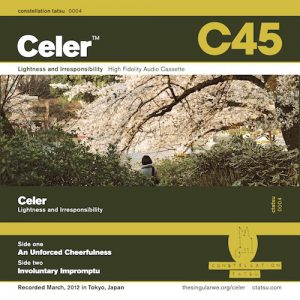
This is actually another brand new Celer release, dropped on the 22nd June. It was so new, in fact, that I had to make its own profile on Rate Your Music. I must say I was rather confused initially when I didnt see it there, before I checked the release date on his Bandcamp. You can listen for free on Bandcamp, as well as purchase as a Limited Edition cassette.

It’s slightly alarming to think that Lightness and Irresponsibility is Celer’s 8th album release this year; there are thousands of artists who wont release 8 albums over their entire career. Celer produces music at a terrifying rate, far too fast for anyone to even hope to keep up with. You’d have to be a serious fan to have listened to all 60+ albums they’ve release over the last 6 years. Luckily, most of his/their work is of a similar level of quality, so it is possible to dip in almost anywhere and start listening.

The other 2012 Celer album I reviewed was Evaporate and Wonder, a deliciously delicate, heartbreakingly beautiful release, filled with 40 minutes of shimmering, careful drones. This album is very much in the same vein if not, dare I say it, even quieter. My house in the day isn’t a terribly noisy place (at times), but I’m having to turn my volume slider to maximum to really hear it. Updating the ReplayGain in Foobar is helping give it some extra welly.

“An Unforced Cheerfulness” has already been playing for 18 of its 20 minutes, and I have no idea what I’ve done with that time. It has slowly been building for its entire duration; a sad, thoughtful sound, with brighter drone sequences weaving and unravelling as a deeper, darker, bassier drone begins to emerge in the latter half. It’s a curious piece, unfolding out of air very slowly, its wistful tones bearing an ounce of optimism, a wry smile behind an otherwise unhappy face.

“Involuntary Impromptu” is a different animal; a deep sub-bass permeates the core of this piece, breaking the surface every so often with a rumbling roar. Airy drone fragments dance and float around the cresting bass before growing more isolated and just hanging in the foreground until they’ve run their course. There’s a great deal more activity here, and it’s not submissive either. The bassier, almost orchestral pulses, are big, bold and determined inclusions that mirror the “impromptu” thought process that went into creating them.

Once again, titles and names tell as much of a story as the music itself; there is a childlike innocence and contentedness here, it feels like a burden has been shed and life has gotten more carefree. There is a tinge of sadness in the first track but there’s also an unselfish happiness, followed by a bigger, bolder track than before as our responsibilities are jettisoned and life gets more spontaneous as the world and its possibilities open up before us. It’s quite a protracted way of saying that even though things may look bad in your world right now, the load will eventually lighten, and when it does you’re allowed to be happy and do things that you want to do.

Link

Clearly satisfied by the outcome of their first seven-inch release, Maastunnel/Mt. Mitake, Will Long and Rutger Zuydervelt return for another installment, this one similar in concept and titledNuma/Penarie. Put together in Tokyo and Rotterdam earlier this year, the two tracks contain original sound elements stitched together from longer source material, and the release is enhanced by its postcard collage presentation and two complementary videos created by Marco Douma.

The tracks themselves are a contrasting pair, the first “Numa” very much in the Celer tradition in fashioning a mood of becalmed iridescence, even if some measure of turbulence briefly intervenes halfway through its five-minute run. “Penarie” immediately distances itself from the other in opening with horn-like synth flurries, though it, too, gravitates repeatedly in the direction of soothing splendour. In both pieces, one often witnesses an ongoing oscillation between the ambient stylings of Celer and the rougher textural play of Machinefabriek. Needless to say, that’s a good thing, as the collaborators’ respective tendencies render the material less homogenous and predictable than it otherwise might be.

Douma’s videos form a nice part of the package as they evolve in accordance with changes in the musical textures—as the music becomes grainier, so too does the video display. “Numa” offers a logical analogue to the musical material as it’s abstract in nature but powerfully evocative, with the visual content suggestive of sunlight reflections on rippling surfaces and showing geometric shapes viewed through a prismatic mist. By contrast, real-world elements, such as electrical towers and hydro wires, appear more identifiably during “Penarie,” though the video retains the dream-like quality of “Numa.”

Link