Posts from the Celer Category

Celer’s output over recent times has been prolific to say the least, and now Will Long (one-half of the duo) sets up his own label, Two Acorns. For this new imprint’s inaugural release Celer collaborate with Japanese artist Yui Onodera, with mastering duties performed by 12k boss Taylor Deupree. While much of the established Celer sound centres upon thoughtful, droning austerity this album is given a very different shape by extensive field recording work from both Los Angeles and Japan involved. Woven into this tapestry of environmental sounds and floating tonality you’ll hear migratory birds, ice breaking on a frozen lake, temple bells and sounds made by people in restaurants or on public transport systems. It’s becoming difficult to keep up with Celer’s release schedule, but it’s still well worth trying to maintain pace – Generic City benefits from Onodera’s additional pair of ears, and the final mix strikes up a deftly poised balance between beautiful ambience and more revelatory acousmatic material; in its finest moments Generic City offers an absorbing, occasionally hallucinatory portal into the audio topography of urban spaces.

http://boomkat.com/cds/352607-yui-onodera-celer-generic-city

Our album ‘Compositions For Cassette’ has been reissued by the cassette label Avant Archive, and is now available! Sincere thanks to Michael for making this special album available once again.

Find it here: http://avantarchive.com/catalog/index.php

Press release:

Celer’s Compositions for Cassette remains one of the duo’s most curious and exploratory works. This is Celer on a noble mission, with clearly defined rules and a very limited toolset. Over the course of twelve pieces, Will and Danielle gush their customary mysterious-yet-gorgeous sound, but in this particular case it is all built from brief piano loops recorded to quickly-decaying tape. The pieces are perforated all over, some of them appearing almost only as ghosts of what they might have once been. It’s an apropos approach for this couple who have such a distinct reputation for almost defining that controversial ‘genre’: ‘drone’. This reissue edition collects the original compositions now on Avant Archive’s customary high-bias chrome cassette, and it includes an original artwork and layout by Johnny Utterback, as well as some combinative photography and layout created in a collaborative process between Will Long and Avant Archive.

Generic City is an almost perfect execution of collaborating. Performing together are two reputable acts in ambient and experimental music, consisting of Japanese composer and multi-instrumentalist Yui Onodera as well as the prolific Californian duo of Celer. With both collaborators being immensely talented in their own rights, the pooling of their separate ideas has equated to four movements of boundlessly stellar exploration.

These 47 minutes represent a combination of two cultures and lifestyles from each of their perspectives. Yui Onodera incorporates recordings of Japans variety of customs: children playing, temple bells, voices in prayer to Buddha, among many others. Celer present sounds from the metropolitan lifestyle of Los Angeles: cars passing, conversations between people in restaurants, pedestrians within a plethora of other sounds. All of this incorporated found sound from their locations is intertwined with the use of musical instruments as well; guitar, electronics, violin, cello, and even more unconventional instrumentation like theremin and ocarina.

Rather than accenting the music itself, the field recordings are the main attraction on Generic City. Surely, the instrumentation and the ecoacoustics are in constant rotation– however the music is exceptionally minimal, with resonating hums that manifest within an attentive listen. This leaves all heads turned toward the atmospheres of each location, which bleed into one another seamlessly and allow the urban theme of these four pieces to come full circle.

Onodera and Celer acknowledge that both settings aren’t meant to be seen as two unrelated parts of the world, or a side-by-side comparison of the two cultures– but make note that though geographically distanced, these concepts are connected by nature. Generic City alludes to the idea that musicians are subconsciously influenced by their environment, and the way that the artists’ music blends with nature strongly represents this idea.

http://olive-music.blogspot.com/2010/11/review-yui-onodera-celer-generic-city.html

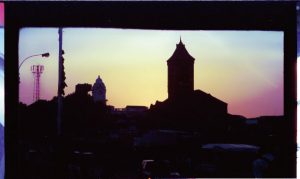
For a long time now, I’ve been going through all of the photos that Danielle took while on her travels in India, Nepal, Sri Lanka, and Pakistan. I’ve collected them all through various prints, negatives, and slides, scanning and compiling them all for a photography book of her work for the future. In going through the negatives, and scanning them directly, I came across this image, which I hadn’t seen anywhere until that point. Most of the images were printed, and collected in several large photo albums, but not this particular frame.

I realized, since the photo is not clear-cut, and it does contain some defects and errors, as wel as bleeding onto other frames, that despite its beauty, possibly when the film was developed it was skipped over, and not printed. Personally, this is a common problem, and when revisiting negatives sometimes I find some of my best photos in the vaults of the negatives that photo labs had skipped over. It occurred to me that its very probable that Danielle never actually was able to see the results from this photo, taken somewhere unnamed on her travels, but only when she originally took the photo on that glowing evening.

In searching for the proper artwork for our album ‘Generic City’, the circumstances and preservation of this photograph seemed absolutely perfect to me, and in many ways its preservation though featuring it as our artwork made it even more special. It’s likely I won’t ever be able to find out where exactly this photo was taken, but in the end I think its vagueness and beauty transcends the need to be defined, letting it exist simply as it is.

Celer & Yui Onodera’s collaboration, Generic City, is the inaugural release on Celer’s new label Two Acorns…

The function of good artworks, I have often read, is to provoke a reaction. Talented artists are able to elicit a response – they hold a mirror up to a person’s perception of themselves, their place in the world; making them confront a perspective that they hold and forcing them to re-evaluate it in a new light.

For example, a painting in a gallery that you dismiss on the first viewing, but find yourself drawn back to in curiosity. Stepping back a bit. Angling your head. Looking at it from a diagonal angle. There’s SOMETHING about it, but you’re not quite sure what…

Your reaction to it is solely based on what you bring to it; you are responding to what you see by reacting to your own point of view.

Those that live in cities will likely have a similar reaction to Generic City. Everyone’s perception of a metropolis is different, and this release will conjure different memories and impressions from one person to the next. It is sufficiently abstract to be able to project your own experience onto it, but also possessing enough character to be able to take a message from it.

The four tracks presented are artful meshes of field recordings, electronics, guitar, cello, violin, piano, environmental sound, Theremin, and ocarina; all recorded and composed from 2007 to 2009. All are long, none shorter than nine minutes and the longest clocking in at close to seventeen, although the length of the tracks is deceptive – it sounds different once you are on the inside. The field recordings are of varying tones and textures, some quiet and reticent, some more rambunctious and unruly.

On first viewing, these paintings do not seem to have a common theme, but upon further listens a thread emerges – in the first track, the electronic sounds slowly become less and less processed, finishing with a solitary music box. Inspection of the notes accompanying the release mention that the musical sounds were made from that one original acoustic recording of the music box, made dozens of ways, fading into the instrument by itself.

The track, “An Imaginary Tale of Lost Vernacular” is a fitting starting point, an enigmatic and intriguing mood piece that over multiple listens reveals different facets of itself. It’s representative of the album as a whole – it presents initially as quite aloof but repeated exposure draws a response from the listener, depending on what they are bringing to it.

Worth seeking the release out for the second track alone, such is the strength of “Waiting Until Something Else Happens”. A pretty evocative drone introduction followed by stereoscopic sound design. An artful rumination on plane noise to fade.

“The Street Of A Rainy, Gray Day” is just that – reflected sunlight off the street, clicks, raindrops and puddles. There’s an atonal simulation of nondescript background clatter that certainly adds to the effect. Some shuddering tremolo tones add to the tension, and passing conversation and bird noise could well be the street heard from the alley, echoing and vague.

“A Renewed Awareness of Home” is unexpectedly musical. It has the quality that I’m sure all field recordists aspire to, in that it’s a melodic soundscape, not merely a collection of textures. It most overtly captures the Eastern influence that is discernable throughout the tracks.

The hypnotic nature of all the tracks is a strong point – it has a lulling effect, creating a space that gives a different context to the textures presented in the recordings. I noticed at one point that I’d been paying attention to the interaction and placing of the musical parts, and had completely failed to notice that one field texture had faded into a completely different sound, and that the tone of the whole piece had changed without me detecting it. Taylor Deupree handled mastering, and the canvas is surprisingly even given the considerable difference in tones used.

It is that rarest of beasts – on an initial sighting it seems to be perfunctory and unremarkable, but upon further inspection it reveals itself to be an elegant and thoughtful work, deserving of repeat viewing.

Like good artwork.

By talented artists.

– Review by Alex Gibson for Fluid Radio

http://www.fluid-radio.co.uk/2010/10/celer-yui-onodera-generic-city/

Ambient music, like all electronic music, often displays an uneasy relationship between the final composition & the source materials from which it was made. i believe it was Luc Ferrari who coined the term ‘anecdotal’ for sounds that immediately declare their origins; while field recordings, as an art form, have become an entity in their own right these days, for some, use of such anecdotal sounds is anathema, rupturing the delicate abstract surface for which they strive. There are times when it seems as though Celer echo this sentiment; one only has to spend a little time with Poulaine, for instance, which lists cello, violin, theremin, “contact mics on oil paintings” & field recordings among other things as its sources, all of which are entirely lost, unidentifiable in the resultant ambient soup. That’s not exactly a complaint; i know from experience that the significance of a source can be justification enough for inclusion, irrespective of whether or not its identity is retained—this is music, after all, not documentary footage—&, in any case, on other releases Will & Dani have, indeed, allowed their sources to be more obviously demonstrative, such as Poulaine’s companion release Fountain Glider & Engaged Touches.

It’s particularly striking, then, that the opening track of Generic City, a collaboration by Celer & sound artist Yui Onodera, begins amidst an obvious field recording of the calls & honks of a large flock of what sound like swans. Titled “An Imaginary Tale of Lost Vernacular”, one detects, early on, that ambient textures are present, but they are kept at bay for some minutes before moving into the foreground. This sets the tone for the rest of the album, one in which overtly anecdotal sounds happily coexist with abstract textures; no hints of unease here. Having said that, a lack of unease can’t of itself make the abstract & anecdotal gel—nothing could—yet what Onodera & Celer establish in this track is a continuum of sorts, the music moving freely within the abstract & anecdotal poles, thereby attaining some semblance of unification. Once the abstract material has emerged, it dominates the track, but anecdotal sounds are forever lurking at the fringes, more muted than before, but thereby becoming more allusive, encrusting the music with bells & chimes, until it returns to the fore for the closing minutes. As the track ends, we move back to the anecdotal extreme, & the stark unadorned sound of footsteps walking on gravel; such a world away from that with which most of the previous quarter of an hour has been preoccupied, yet not feeling out of place.

“Waiting Until Something Else Happens” goes further, seeking to integrate the two kinds of material more thoroughly. It opens in pure ambience, the music softly rising & falling, but noise quickly takes up position at the edges once again; over time, the noise begins to make inroads, its gestures adorning & ultimately overwhelming the more gentle tones beneath. They usher in the track’s central section, a protracted episode where field recordings made at an airport take centre stage, culminating in more noise, the combination of plane sounds & water, blurring the distinction between the raw & the cooked; it’s impossible to tell, in fact, what’s sonically ‘real’ & what’s not at moments like this. The final couple of minutes are a stylistic recapitulation of sorts, all ambience, an exercise in gorgeous shimmering.

From the first couple of tracks, it’s clear that unification works best when the sharp, anecdotal edge of the field recordings is blunted somewhat, & this is demonstrated early on in “The Street Of A Rainy, Gray Day”. It’s a much more complex track, the foreground in flux, both kinds of material juxtaposed in quick succession. Generic City’s most effective moments are heard here; a sense of the abstract is what projects most, but one is constantly aware of fragments & gestures hinting at something familiar, tantalisingly kept just beyond the reach of recognition. Once again, this is diffused into a dense cloud of noise, before a strident chord, laden with pulsing overtones, appears, propelling the track in a new direction. For the rest of its duration, the impetus is maintained; field recordings often push to the front, yet for all their clarity, direct recognition remains difficult. Material constantly morphs back & forth, teasing the ear at the cusp of identity, one moment forming amorphous oscillations, another dissolving into a vast texture of busy street noise. There’s not one moment of this track that fails to engage & ignite the imagination, & it’s a very fine example indeed of the kind of fascinating interplay that can result from such disparate types of source material.

Generic City closes with “A Renewed Awareness of Home”, a mysterious slab of sound occupying a darker ambient world. The first four minutes are masterful; a viscous miasma is established, moving with the pace of tectonic plates, hypnotising the ear. The first occurence of something other comes as a shock (in fact, on first listening i actually believed the sound to have come from somewhere else); metallic strikes periodically blanch the surface of the ambient cloud, causing it to shift & alter in consistency. It’s magical stuff; unfortunately, the entrancing mood is emphatically broken by the ensuing abrupt appearance of chanting voices. In theory, such sounds ought to fit right in with the established soundworld; sadly, however, they jar unpleasantly, shattering the carefully balanced texture, the opening few minutes quickly lost & forgotten. The field recordings finally subside into another abstract episode, but it’s an altogether brighter one, & as such, only seems to worsen the overall effect.

This is, however, a very rare example of ill-judged/executed sound juxtaposition from these otherwise superb musicians; & despite the difficulties of the final track, Generic City is otherwise a tour de force of electroacoustic music. It’s really exciting to hear the anecdotal & the abstract co-exist in such a unified & fruitful way.

http://5-against-4.blogspot.com/
A highly emotional record, Engaged Touches is imbued with a sense of longing. With loops, strings and field recordings, this husband-wife duo have crafted a lush, captivating album that reflects long distances and separation. The first track plays train sounds off of gentle, ambient string loops that seem to stretch to infinity. Deep listening reveals a plethora of subtle undertones hiding beneath the surface. Clocking in at roughly 20 minutes, this piece is a mere warm-up for the more ambitious second track. Beginning with a dense cluster of piano notes, this 40-minute tone poem is a touch more sombre than its predecessor; it is no less gorgeous, however. That Engaged Touches was composed following a train trip that the couple took across Canada is no surprise; its grandiose bliss is the perfect summation of our vast, multifaceted landscape. – Bryon Hayes

http://exclaim.ca/Reviews/ImprovAndAvantGarde/Celer-Engaged_Touches/

普段の生活で彼らが視ている事物は多層的であり、多様性をもったものである。それは所謂、芸術家と呼ばれている人達だけではなく、社会全体の生活者も同様に独自の視野を持っている。Yui Onodera とCeler がそれぞれの生活の場の中から沸き上がってきた思考を具体化したコラボレーション作品は、リスナーの再生装置から発せられた瞬間に完結し、部屋に絵や花を飾るのと同じように、彼等の音楽はその空間の一瞬と一部になる。同時に彼等のパーソナルな部分は消え、彼等もそこにはいない。彼等は音以外の領域もデザインしている。デザインはネガティブな側面も材料にし、アップデートを繰り返してゆくが、この息苦しい世相に対して、彼等の作品は生活に静かな彩りを与えてくれる。僕にはその様に聴こえてきた。

Things that they see in usual life are multilayered, and have diversity. Not only people who are called “Artists”, but also the dwellers of the whole society have an original view.

The collaboration work by Yui Onodera and Celer was materialized of an idea that came from among each life scene; it is concluded when listeners play it, and Their music becomes the moment and a part of the listeners’ space, in the same way as the decoration of a room with a picture and a flower.

Their personal part disappears, and it is not them either at the same time. They are designing the areas other than the sound. The design gives a negative side to the material, and repeatedly it is updating itself, but their work gives life a quiet coloring for these stifling social conditions.

It sounds like that to me.

Yukitomo Hamasaki, mAtter (www.matter.jp)

”Generic City”において、アーティストたちは、日本とアメリカでそれぞれ無数の「ローカル」なサウンドをフィールドレコーディングした。海で隔てられた2つの国で得られたサウンドスケープは時には原型のまま、時には激しくプロセスされ、切り取られ 、重ねられ、きわめて注意深く加えられた楽器の音と結びつけられ、いつしか、別の新しい「時間と空間」として機能し始める。現実から跳躍する。このアルバムは、音で新しい世界を再構築する技量を持った3人の若いアーティストから届けられた特別な旅の記録だ。目を閉じて、じっくり味わいたいと思う。

一ノ瀬響(音楽家)

In “Generic City”, the Artists recorded so many “local” sounds in each country. Soundscapes which were obtained in two countries, being kept in original shapes or being heavily processed, were cropped, mixed with each other, combined with carefully contributed instrument sounds and finally worked as another new “time space”. It leaps the reality. This album is the record of a series of special travels delivered from three young artists who can rebuild a new world by sounds with grounded skills. I’d love to listen to it, with closed eyes.

Kyo Ichinose (Musician)
http://www.kyo-ichinose.net/

Celer, a group whose unfortunate dissolution threatens to stand no more than waist-high to their release schedule, emits two more long-playing discs. With recordings dating to two and three years ago, the pair’s free-floating sound is hardly constrained by time, nor form, as the soft-lit drones which comprise the bulk of their work is equally, arbitrarily shot-through with profound little ornaments that resonate only in the gentle vastness in which they are suspended.

In the case of the verbose ‘Panoramic Dreams Bathed in Seldomness’, this non-committal bookkeeping is accomplished through comma and semi-colon, as the disc’s four tracks are split in fact upwards of eight ways, if not through divided movements than at least through unsettled questions for the author. We have divined something, but what is it? It seems to be an archival task which has out-raced the creative process of whittling raw material that has been composited into a single piece. Nevertheless, the rich bass tones of “Collections of Fogs and Ladling Clarities” nicely complicates the Hammock-y optimism which threatens to choke the first part of track one, “Anticline Rests; Inertia Brace Yourself”; over and between minor and dissonant chords, a watery chant rounds over yet passes as does the fear of being swallowed, a bluff which Celer is still, to their credit, able to pull-off. “Who Feels Like Me, Who Wants Like Me, Who Doubts Any Good Will Come Of This” follows, actually an entirely singular piece but one with implied “doubts”, a neo-classical contour of elegant melancholy and surprising depth. The disc is rounded out with a 20-minute drone duet, static yet noble and entirely representative of the group, except when it grinds to a halt.

Illuminating a young Los Angeles label with one of the brightest sparks from their obscene post-production derailment, Celer share the carefully-prepared ‘Dying Star’ with even more careful instructions to emphasize the most-delicate nature of this release. Appropriately prompted with a liner notes quote from Merleau-Ponty, the music can best, perhaps only, be articulated phenomenologically, as a sensual experience not to be reduced or rationalized to its technical, conceptual, or informational core. Improvised without edit from analog synthesizer and mixer, the sound is as sparse yet engrossing as those “no-input” works which appear now and again, with droning hues of electromagnetism which barely register when listened to with a hand on the volume knob (in my mind, though not theirs, the better way to appreciate the disc). But rather than read into the machine-soul as so many such works provoke us to do, these emotive sounds do no more than that, selecting – not describing – a feeling, and then paired to an individual’s sentiment in perfect little micro-poems (“How I Imagine My Hand Holds Yours”, “On The Edges Of Each Season”, “I Could Almost Disperse”). Though the focus of each track seems to strike at the same point in the ear (i.e. the same emotion, the same sentiment) – and the blending together is hardly a distraction – the tracks vary widely in length. Though it may be claimed these are to encapsulate each fleeting (that is, to different degrees) feeling, it strikes me that the impression is already made, and doubly quick with the very effective titling scheme. Rather, I think the longer durations belong wholly to the authors, who linger (some may say over-interested, and therefore narcissistically), doubling the experience by already feeling for us. CD comes tabbed to an oversized, inkjet print in a very optimistic run of 500 copies.

http://www.animalpsi.com